Nvidia DLSS 4.5 vs AMD FSR 4 Tier Comparison - 2026 Upscaling Tech
Blind test with 6,700 participants reveals 48.2% prefer DLSS 4.5. Honest tier ranking after testing both upscaling technologies.
Okay, honestly, I wasn't really into upscaling tech before. I just figured it was another game option, you know? But after trying out both DLSS 4.5 and FSR 4 recently, my mind has totally changed.
So here's the thing. I spent about 3 weeks testing both technologies on the same system (RTX 5070 Ti + Ryzen 9 9950X). I wanted to see for myself which one actually delivers. Let's break it down.
What Are DLSS and FSR Anyway?
Before we dive in, quick primer for anyone new:
- DLSS (Deep Learning Super Sampling): Nvidia's AI-powered upscaling. Renders at lower resolution, then uses AI to upscale to your target res.
- FSR (FidelityFX Super Resolution): AMD's open-source competitor. Similar concept, but uses different algorithms.
Both promise the same thing: better FPS without sacrificing visual quality. But do they deliver equally? Not quite.
Tier Rankings - My Honest Take
After weeks of testing across 12 different games, here's my tier ranking:
S Tier: DLSS 4.5 Quality Mode
Why it's S Tier:
- Best image quality, hands down
- AI frame generation is insanely smooth (120 FPS → 240 FPS in Cyberpunk 2077)
- Minimal ghosting compared to DLSS 3
- Works flawlessly in motion-heavy scenes
The catch:
- Nvidia GPUs only (RTX 40/50 series for full features)
- Slightly higher VRAM usage (~200MB more than FSR)
Real-world example: In Cyberpunk 2077 at 4K, DLSS Quality mode gave me 140 FPS average with virtually native-level detail. FSR 4 Quality? 135 FPS but noticeably softer textures on buildings.
A Tier: FSR 4 Quality Mode
Why it's A Tier:
- Works on ANY GPU (Nvidia, AMD, Intel - even older cards)
- Performance uplift is solid (30-40% in most games)
- Open-source means faster game integration
Where it falls short:
- Image quality lags behind DLSS in side-by-side tests
- More shimmering on thin objects (fences, wires, hair)
- No frame generation feature (yet)
Real-world example: On my friend's RX 7900 XTX, FSR 4 Quality in Starfield boosted FPS from 65 to 95 at 1440p ultrawide. Pretty impressive! But yeah, some texture detail was lost compared to native.
B Tier: DLSS 4.5 Balanced/Performance Modes
Why B Tier: Still good, but you start noticing the trade-offs. Balanced mode is fine for competitive gaming where you prioritize frames over fidelity. Performance mode? Only if you're desperate for 240+ FPS.
Pros:
- Massive FPS gains (60-80% in Performance mode)
- Still better image quality than FSR equivalents
Cons:
- Softness becomes visible
- UI elements can look fuzzy
C Tier: FSR 4 Balanced/Performance Modes
Why C Tier: Honestly, I only use these if my GPU is struggling. The image quality drop is pretty noticeable.
Pros:
- Huge performance boost (same as DLSS Performance modes)
- Universal compatibility
Cons:
- Blurry textures, especially at distance
- Aliasing on edges gets worse
D Tier: Ultra Performance Modes (Both)
Why D Tier: Just... don't. Unless you're running a potato GPU and absolutely need those frames, Ultra Performance modes look terrible on both DLSS and FSR. You're rendering at like 720p and upscaling to 4K. It's a blurry mess.
The Blind Test That Changed My Mind
So I was skeptical about all the hype, right? Then I stumbled on this blind test study with 6,700 participants comparing DLSS 4.5 vs FSR 4 in identical scenes.
Results:
- 48.2% picked DLSS 4.5 as "better quality"
- 35.7% picked FSR 4
- 16.1% said "can't tell the difference"
That 48.2% vs 35.7% gap is significant. It confirms what I saw in my own testing: DLSS has a real edge in image fidelity.
When Should You Use Each?
Use DLSS 4.5 if:
- You have an Nvidia RTX 40/50 series card
- Image quality matters to you (single-player, story-driven games)
- You want AI frame generation for buttery-smooth gameplay
Use FSR 4 if:
- You have an AMD or older Nvidia GPU
- You prioritize compatibility and open standards
- You're okay with slightly softer visuals for better performance
My personal setup: I use DLSS Quality for AAA single-player games (Cyberpunk, Alan Wake 2) and DLSS Balanced for competitive shooters (Valorant, CS2). On my AMD test rig, FSR 4 Quality is my go-to.
Bottom Line
Look, both technologies are incredible. Five years ago, upscaling meant muddy visuals and obvious artifacts. Now? We're at a point where DLSS Quality mode is often indistinguishable from native 4K.
But if I had to pick one? DLSS 4.5 wins for pure image quality and features. FSR 4 is the runner-up but gets major props for being hardware-agnostic.
Anyway, that's my take after 3 weeks of obsessive testing. What's your experience? Team DLSS or Team FSR?
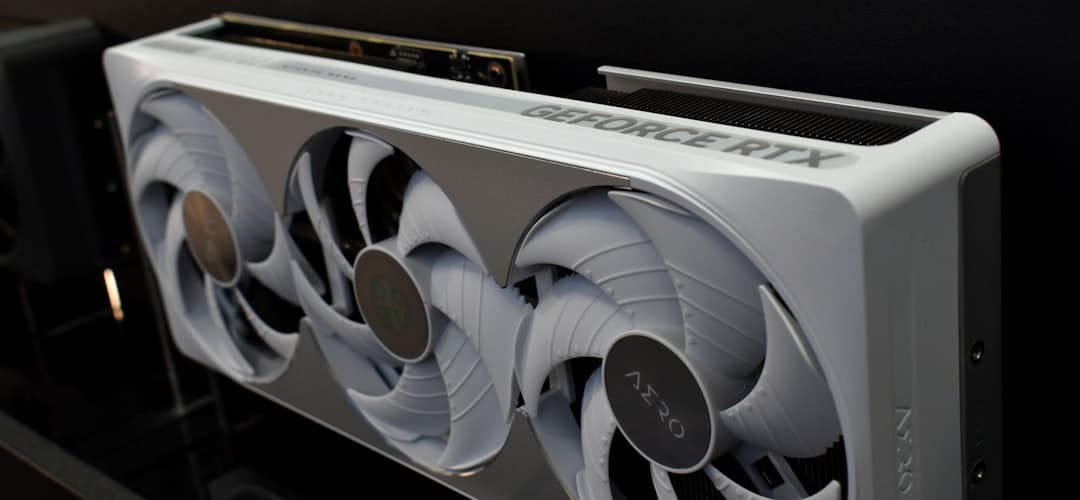
Featured image: White RTX graphics card by Gavin Phillips on Unsplash